
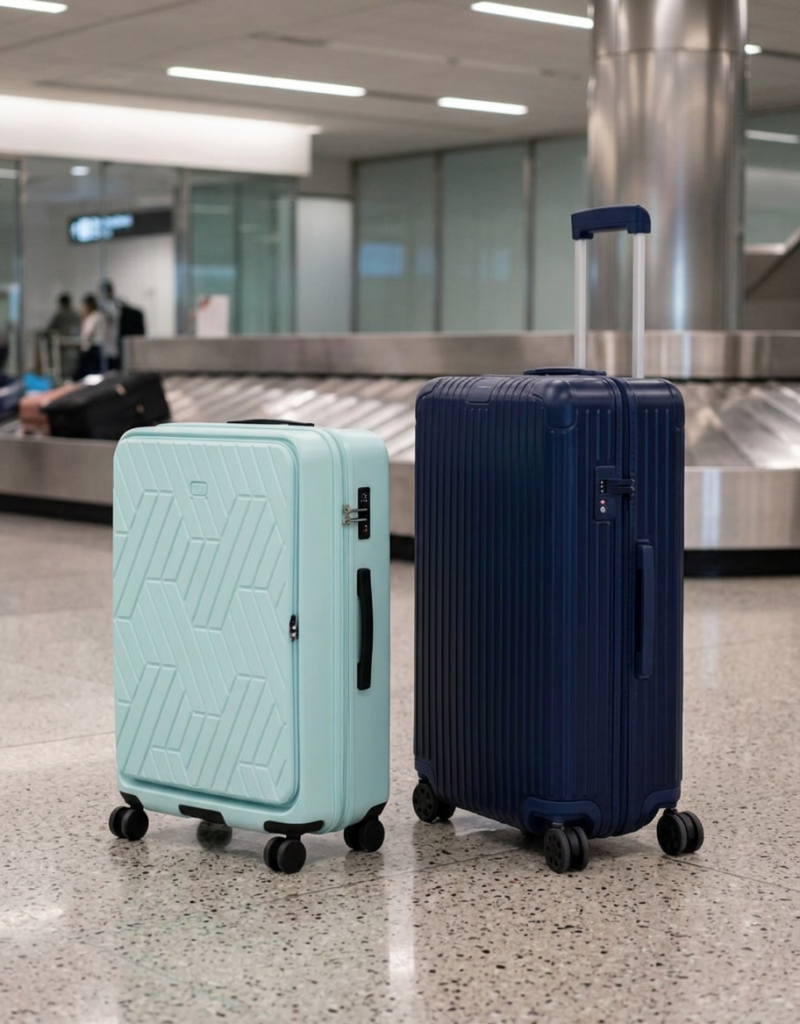
Most people buy a suitcase based on color, brand, or wheel configuration. The opening mechanism — whether the bag splits in half like a book or opens from the top — barely gets a second thought. That’s a mistake that ends up costing you time, stress, and reorganization every single trip.
The difference between a top loading suitcase and a traditional clamshell design isn’t just aesthetic. It fundamentally changes how you interact with your luggage from the moment you start packing to the second you unzip at your hotel. And once you understand the structural logic behind each format, it becomes hard to unsee why one approach works significantly better for most real-world travel situations.
Quick answer: Top loading suitcases offer meaningfully easier packing and mid-trip access than clamshell designs. Because you access contents from one opening rather than splitting the bag entirely, you can pack sequentially, access items without unpacking everything, and keep clothing compressed and organized more naturally. For most travelers, this translates to less chaos and less time spent packing and repacking.
Why top loading beats clamshell for most travelers:
-
You can access your bag without clearing floor space for both halves
-
Items stay organized during partial unpacking
-
Compression is more consistent throughout the main compartment
-
Packing and unpacking follows a logical, layered sequence
-
Works better on luggage racks, hotel floors, and cramped hostel bunks
Key Takeaways
-
Top loading suitcases allow access without fully opening the bag, which reduces disruption during multi-day trips
-
Clamshell designs have legitimate advantages for certain packing styles and trip types
-
The opening mechanism interacts with how you pack, not just how you access items
-
Hard-sided top loading options combine structural protection with better access logic
-
Understanding your travel pattern is more useful than following a blanket recommendation
What Actually Makes a Suitcase “Top Loading”
The term gets used loosely, so it’s worth being precise. A top loading suitcase opens from the top of the bag rather than splitting down the middle. The zipper or opening runs along the perimeter of the top face, allowing you to reach into the main compartment from above — the way you’d use a duffel bag or a traditional trunk.
This is distinct from a clamshell design, where the bag splits into two roughly equal halves held together by a hinge or zipper along the sides and bottom. When a clamshell opens, both sides fold flat and the bag essentially doubles its footprint.
There are also hybrid designs that offer both access points — a clamshell structure with an additional top or front access panel. These exist, but they’re worth treating as a separate category because they solve different problems than a true top loader.
The distinction matters because the opening style determines your entire packing logic. A clamshell invites you to pack both sides simultaneously, with a divider in the middle. A top loader invites you to pack in layers, working from the bottom up.
The Packing Access Problem Nobody Talks About
Here’s the scenario that exposes why clamshell design creates friction:
You’re three days into a five-day trip. You need the charger that’s buried on the left side of your clamshell bag. To get to it, you need to open the bag completely — which means finding floor space large enough to lay both halves flat, moving everything stacked on top of the suitcase, and then either digging through compressed clothing or removing the mesh divider panel to get access.
Meanwhile, the person with a top loading bag unzips from the top, reaches in, and moves on with their day.
This isn’t a hypothetical edge case. It’s a consistent friction point for anyone who lives out of a suitcase rather than simply unpacking into a hotel dresser. The clamshell format essentially assumes you’ll unpack everything completely and repack from scratch at each destination. That’s a reasonable assumption for some travelers — but it’s not how most people actually behave.
Top loading bags assume something closer to the truth: that you’ll frequently need partial access, that contents shift and compress during transit, and that your packing approach should work with gravity rather than against it.
Introducing the Carry Friction Index
One way to evaluate opening mechanisms — or any design feature on luggage — is through what we call the Carry Friction Index (CFI). The CFI measures how much resistance a design feature creates against your actual travel behavior. The higher the friction, the more the bag works against you.
How the Carry Friction Index works:
Score each factor from 1 (low friction) to 5 (high friction):
| Factor | Top Loading | Clamshell |
| Mid-trip partial access | 1 | 4 |
| Required floor space to open | 1 | 4 |
| Packing in tight spaces | 2 | 4 |
| Initial full pack organization | 2 | 2 |
| Visibility of all items at once | 3 | 1 |
| Wrinkle-prone clothing | 2 | 2 |
| Airport security re-packing | 1 | 3 |
| Overhead bin partial access | 1 | 5 |
CFI Total — Top Loading: 13 / 40
CFI Total — Clamshell: 25 / 40
Lower scores indicate less friction against typical travel behavior. The CFI isn’t about which bag is “better” in isolation — it’s about which design aligns with how you realistically use luggage.
Reference the CFI when evaluating any design feature. If a feature consistently scores high across your actual travel patterns, it’s adding friction, not value.
Why Easier Packing Isn’t Just a Convenience — It’s a Systems Issue
The real cost of high-friction luggage isn’t the extra two minutes you spend accessing your bag. It’s the cumulative decision fatigue, disorganization, and mental overhead that builds up across a trip.
When you can access your bag easily and intuitively, you’re more likely to maintain your packing system. When access is difficult, you start making compromises — throwing things in haphazardly because the effort of doing it properly is too high. This is especially true on return trips, when motivation to pack carefully is at its lowest.
Top loading design supports what organizational psychology calls low-friction maintenance — the idea that a system is only as good as how easy it is to maintain over time, not just how well it’s set up initially. A well-organized clamshell bag at departure often looks like a chaotic mess by day three, not because the packer failed, but because the design made maintaining organization harder than abandoning it.
This is also why top loading bags pair so naturally with packing cubes. When you pack cubes into a top loader, you’re essentially creating a modular system where individual units can be removed, accessed, and replaced without disturbing the rest of the contents. Pull out the cube you need, use it, put it back. The bag stays organized because the design supports the behavior.
The Case for Hard-Sided Top Loading Luggage
Most of the top loading luggage conversation centers around soft-sided bags — duffels, canvas weekenders, fabric suitcases. But hard-sided top loading designs are worth serious attention, particularly for checked luggage.
Hard-sided cases offer structural protection that soft-sided bags simply can’t match. For fragile items, electronics, or anything that would suffer from compression by airport baggage handlers, a rigid shell matters. The traditional problem was that hard-sided bags were almost exclusively clamshell — giving you protection at the expense of access logic.
Hard-sided top loading suitcases solve that trade-off directly. You get the structural integrity of a rigid case with the access and organization advantages of a top-opening design.
For travelers who check luggage regularly and need reliable protection without sacrificing the ability to access the bag mid-trip, a hard-sided top loader is often the smartest structural choice. The design also tends to be more aerodynamic in terms of exterior profile, which means less damage from other bags being stacked or shoved against it in cargo holds.
If you’re looking for a concrete example of this format done well, the Box Truck Hard Sided Wheelie Checked Bag by the brand Lug is worth examining closely. It brings the top-loading access logic into a hard-sided, wheelie-equipped checked bag — addressing the exact friction points that make traditional hard-shell clamshell cases frustrating for real-world use. The format makes sense structurally, and the wheelie configuration means you’re not trading portability for access.
When Clamshell Actually Wins
Honest analysis requires acknowledging where clamshell design holds a genuine advantage.
Full visibility packing: If you lay everything out, arrange it carefully, and pack once, a clamshell gives you a bird’s eye view of your entire load simultaneously. For meticulous packers who treat packing as a one-time event at the start of a trip, this is a real benefit.
Flat-packing dress clothes: Suits, blazers, and formal dresses travel better in clamshell designs where they can lie completely flat without any folding at the bottom. Top loaders require folding at some point in the stack.
Two-sided compartmentalization: The natural two-halves structure of a clamshell makes separating clean clothes from worn clothes intuitive. One side clean, one side used — it’s a simple mental model that works well for week-long trips.
Established packing cube ecosystems: If you’ve built your packing cube system around clamshell access — meaning your cubes are organized left-to-right rather than bottom-to-top — switching designs requires rethinking your whole approach.
The honest answer is that clamshell bags aren’t poorly designed. They’re designed for a particular kind of packer. If your travel behavior matches what clamshell assumes — careful single-pack, full unpack at each destination, no mid-trip partial access — then the format serves you well.
Most people, though, don’t actually travel that way.
Design Features That Amplify Top Loading Advantages
Not all top loaders are created equally. The access format creates potential advantages, but specific design features determine whether those advantages are fully realized.
Compression Straps Inside the Main Compartment
A top loader without internal compression straps loses clothing to the bottom of the bag every time you open it. Look for cross-straps or built-in compression panels that keep contents layered and accessible without everything shifting downward.
Exterior Quick-Access Pockets
The top loading format for the main compartment is most useful when paired with dedicated exterior pockets for items you access constantly — documents, chargers, a book, headphones. Without exterior pockets, you end up treating your main compartment like a grab bag, which defeats the organizational advantage.
Spinner vs. Two-Wheel Configuration
Top loaders interact differently with wheeling configurations than clamshells. Four-spinner wheels allow you to orient the bag any direction — including standing upright while accessing from the top, which is the most natural position. Two-wheel trolley handles require the bag to tilt, which can shift contents. Spinners amplify the top-loading advantage.
Lid Depth and Opening Angle
A shallow top opening that doesn’t open wide enough to see the full compartment partially negates the access benefit. The lid should open at least 120 degrees and reveal the entire top layer of contents without requiring you to reach blindly.
Top Loading vs. Clamshell: Full Comparison
| Feature | Top Loading | Clamshell |
| Mid-trip access | Excellent | Poor |
| Required open space | Minimal | Large |
| Gravity-assisted packing | Yes | No |
| Packing cube compatibility | Excellent | Good |
| Flat-packing formal wear | Moderate | Excellent |
| Full item visibility | Moderate | Excellent |
| Airport security convenience | High | Moderate |
| Hard-sided option availability | Growing | Widely available |
| Organizational maintenance | Low friction | High friction |
| Return-trip repacking | Easy | Frustrating |
| Best for: | Multi-stop, live-out-of-bag | Pack once, unpack fully |
The Traveler Type Test
Using the Carry Friction Index as a foundation, here’s a quick self-assessment to determine which format actually fits your travel behavior:
You likely benefit more from a top loader if:
-
You travel for 3+ nights and access your bag daily
-
You use packing cubes or a modular system
-
You travel to multiple destinations in one trip
-
You frequently access your bag in airports, trains, or tight hotel rooms
-
You check luggage regularly and want structural protection plus access flexibility
-
You find yourself repacking messily by day two of most trips
Clamshell might serve you better if:
-
You unpack completely at every destination
-
You travel primarily for formal or business occasions requiring flat-packed clothing
-
You pack once and the bag doesn’t open again until you return home
-
You have a perfectly calibrated two-sided packing system built around the format
FAQ
What is a top loading suitcase?
A top loading suitcase opens from the top panel rather than splitting down the middle like a traditional clamshell design. The zipper or opening runs along the perimeter of the top face, allowing you to access contents from above in a layered, sequential way.
Are top loading suitcases better for packing cubes?
Generally yes. Packing cubes slot into a top loader vertically and can be removed or replaced individually without disturbing other contents. The top-opening format treats each cube like a modular unit, making mid-trip access and reorganization significantly easier.
Do top loading suitcases work as carry-on bags?
Yes. Many top loading designs are available in carry-on dimensions. The format is especially useful in overhead bins, where you can open from the top without needing to remove the bag entirely from the bin to access contents.
Is a hard-sided top loading suitcase worth the investment?
For frequent checked-luggage travelers, yes. Hard-sided cases offer structural protection that soft-sided bags can’t match, and the top-loading format adds practical access flexibility that traditional hard-shell clamshells lack. The combination is particularly well-suited for trips involving fragile items or rough baggage handling.
Can you pack formal clothes in a top loading suitcase?
You can, but it requires more careful folding technique than a clamshell. Packing formal items in a dedicated garment packing cube or folding them with tissue paper and placing them near the top of the load helps minimize wrinkling. Clamshell designs have a structural advantage here.
Why do most suitcases still use clamshell design if top loading is better?
Clamshell has been the dominant luggage format for decades, and manufacturing tooling, consumer familiarity, and retail display preferences have all reinforced that dominance. Top loading designs are increasingly available as the luggage market has evolved, particularly in hard-sided and adventure travel categories. Consumer behavior is shifting, but production inertia is slow.
What should I look for in a top loading suitcase?
Prioritize: a lid that opens wide enough to see the full top layer of contents, internal compression straps to keep layers organized, four-spinner wheels for upright access, quality zipper hardware, and exterior quick-access pockets for high-frequency items.
Is the top loading format harder to pack initially?
Not harder — just different. The learning curve is mostly about shifting from a two-sided spatial model to a layered vertical one. Once you internalize that logic, most people find top loading packing faster and more intuitive, especially when using packing cubes as organizational units.
Conclusion
The clamshell suitcase has dominated travel for so long that most people don’t question whether it actually matches how they travel. It does — for some people, in some situations. But for the majority of travelers who access their bag multiple times during a trip, move between destinations, or use packing systems built around modular organization, the top loading format is structurally better suited to real-world use.
The Carry Friction Index is a useful lens here: design features should work with your travel behavior, not require you to adapt your behavior to the design. When you run clamshell and top loading through that framework, the friction difference is consistent and meaningful, particularly for mid-trip access, tight spaces, and maintaining organization across multi-day trips.
None of this means every top loader is better than every clamshell. A cheap top loader with poor internal organization will underperform a well-built clamshell every time. But when quality is comparable, the opening logic of a top-loading design creates fewer moments of friction across the entire arc of a trip — from the first pack to the return-trip shove.
That’s not a small thing. Carry systems that reduce friction across repeated use are the ones you actually stick with. And a bag that works with how you naturally behave is, in the end, a better bag.